"Ozempic face" isn't a medical diagnosis. It's a phrase that went viral because so many people recognised it: cheeks that look a little hollower, under-eye shadows that weren't there last spring, softer jawlines, and skin that seems to sit looser on the face than it used to. Cleveland Clinic describes it simply as the facial changes that can come with rapid weight loss: gauntness, sunken cheeks, new lines and lax skin on the face and neck.
The important word there is rapid. Nothing in the medication acts on the face directly. What changes the face is how much fat is lost and how quickly, which is exactly what modern GLP-1 medicines are so good at. In the trial that led to semaglutide's approval for weight management, participants lost an average of 14.9% of their body weight over 68 weeks. That is a lot of tissue to lose in a little over a year, and the face is not exempt.
So this isn't a side effect of one particular drug. The same thing happens with Wegovy, Mounjaro, Zepbound, after bariatric surgery, or after any fast, substantial weight loss. "Ozempic face" just happens to be the name that stuck.
Your face is built on fat pads
For a long time, facial fat was thought of as a single, continuous blanket under the skin. That changed in 2007, when plastic surgeons Rod Rohrich and Joel Pessa injected dye into cadaver faces and showed that the subcutaneous fat is actually divided into distinct compartments, each with its own boundaries. A year later, the same group described a deep compartment in the medial cheek, sitting beneath the muscles and closer to the bone.
Think of it less like a blanket and more like a set of small cushions, arranged in two tiers. The superficial fat pads sit just beneath the skin: over the forehead, at the temples, under the eyes, through the cheeks, beside the nose and along the jaw. The deep fat pads sit beneath the facial muscles and give the midface its underlying projection. Together they hold the skin up and give a face its soft, continuous contours.
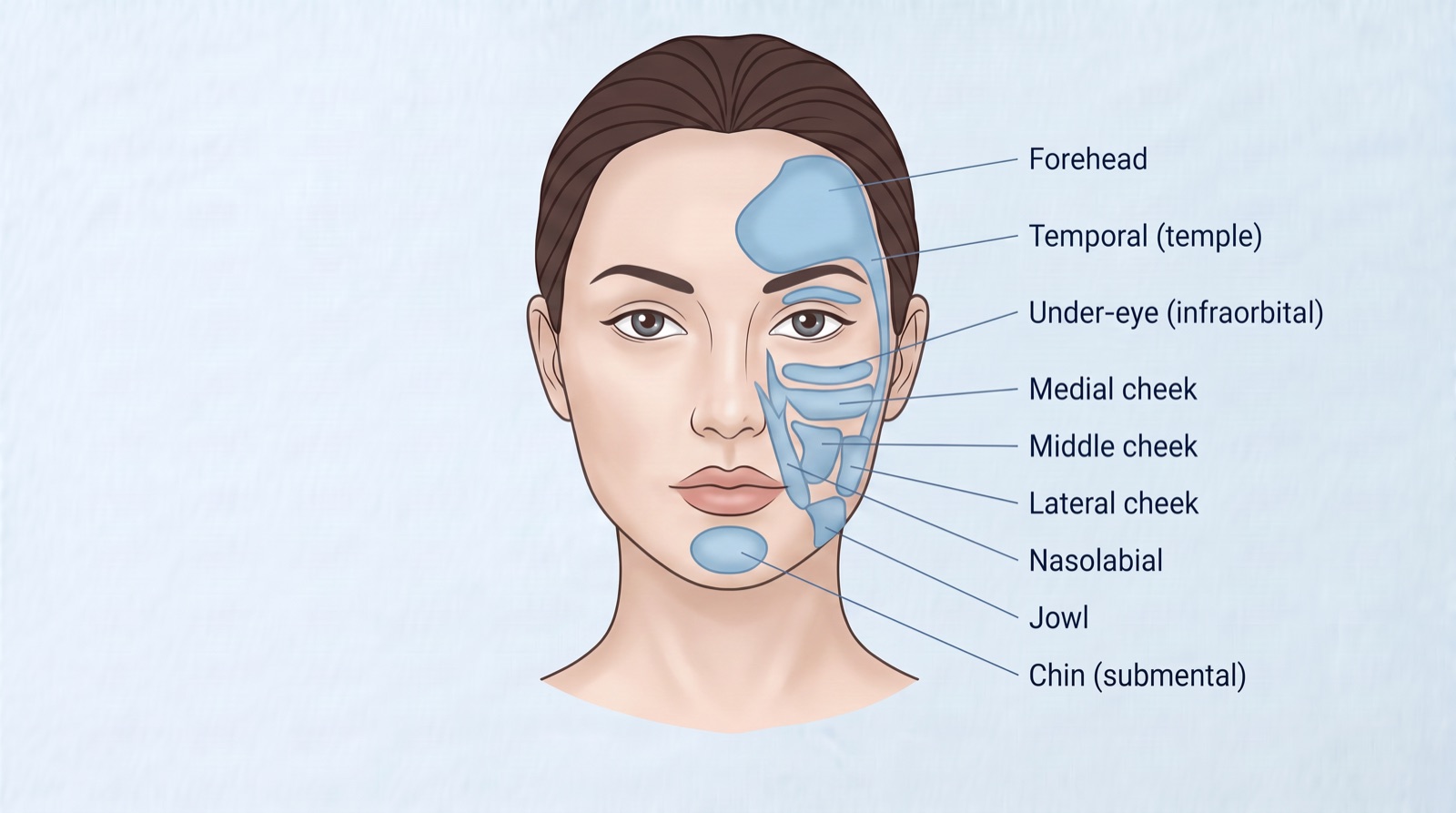
Because these compartments are separate, they don't shrink evenly. When some lose more volume than their neighbours, the transitions between them start to show: a groove under the eye where the lower lid meets the cheek, a deeper line from nose to mouth, a hollow at the temple. That uneven deflation is why weight loss can make a face look not just thinner, but older.
What the scans actually show
Until recently, most of what was said about Ozempic face came from surgeons' and dermatologists' observations. In 2025, a team at Vanderbilt University Medical Center published one of the first studies to measure it directly. They found 20 patients who happened to have had CT or MRI scans of the head both before and after starting a GLP-1 medication, and compared the volume of their midfacial fat.
median loss of superficial midfacial fat volume
midfacial volume lost for every 10 kg of body weight lost
average weight loss in the group studied
Source: Sharma et al., Otolaryngology–Head and Neck Surgery, 2025. Small retrospective study (n = 20).
Two findings stand out. First, the loss tracked weight: the more someone lost overall, the more superficial facial fat went with it. Second, it was mainly the superficial pads that shrank. The deep compartments changed much less consistently, and didn't correlate with how much weight was lost. In other words, it's the cushions just under the skin, the ones that most directly shape how the face looks, that take the hit.
It's a small study, and the authors are clear that more research is needed. But it puts numbers on something people have been noticing in the mirror for a few years now.
What happens, layer by layer
Skin isn't a sheet laid over fat. It's the top of a stack of layers that depend on each other, and when one of them shrinks, the ones above it have to adapt.
1. The superficial fat pads deflate
This is the main event, and what the imaging study measured. Less adipose tissue under the skin means less projection in the cheeks and temples, and less padding under the eyes.
2. The skin doesn't shrink as fast as the fat does
Skin can contract, but slowly, and less so as we get older. When the volume underneath goes in months rather than years, the dermis is left with more surface area than it has structure to fill. It settles into folds and creases, much like a slowly deflating cushion cover.
3. The fat inside the skin changes too
Less well known is that there is also a thin layer of fat within the skin itself, called dermal white adipose tissue. Researchers Kruglikov and Scherer have argued that these dermal fat cells are an overlooked part of skin ageing: they don't just add volume, they release signals that influence the fibroblasts responsible for making collagen and the rest of the dermal matrix. Most of this work is still early and comes from lab studies rather than people on weight loss medication, but it's a plausible part of why skin can look thinner and duller, not just looser, after losing a lot of weight.
4. The underlying structure was already changing
Collagen production declines steadily through adulthood, and years of sun exposure break down what's already there. A 50-year-old and a 30-year-old can lose the same amount of facial fat and look quite different afterwards, because the older dermis has less elasticity to bounce back with.
It isn't the medication that changes the face. It's the speed and scale of the fat loss.
Who is most likely to notice it?
Not everyone who takes a GLP-1 medication develops a noticeably different face. These are the factors that seem to matter most:
01Speed
The faster weight comes off, the less time the skin has to adapt. Cleveland Clinic notes it's more likely with rapid loss.
02Amount
Facial volume loss tracked total weight lost in the imaging study: roughly 7% for every 10 kg.
03Age
Older skin has less collagen and elastin, so it retracts less well once the volume beneath it is gone.
04Sun exposure
UV damage breaks down the dermal matrix over decades. Photo-aged skin shows volume loss more readily.
05Starting face shape
People with naturally lean or angular faces have less reserve, so smaller losses show sooner.
06Genetics
How and where your body stores and loses fat is partly inherited, and the face is no exception.
What actually helps
It's worth saying plainly: losing facial fat isn't dangerous, and it doesn't need treating. The health benefits of reaching a healthier weight are real, and nothing here is a reason to stop a medication that's working for you. But it's reasonable to want your face to look like you, and there are sensible things you can do.
| Approach | What it can and can't do |
|---|---|
| A steady pace | Faster loss gives the skin less time to adapt. If changes are bothering you, discuss the pace of your dose increases with your prescriber. Never change your dose on your own. |
| Protein and strength training | Helps preserve muscle as weight comes off, which supports overall body composition. It won't stop facial fat loss, but it's good advice anyway. |
| Daily SPF 30+ | The single most useful thing for long-term skin quality. It protects the collagen you have while the face adjusts. |
| Targeted skincare | No cream replaces a fat pad. Good skincare can support the dermis above it: barrier function, hydration, and the look of firmness and radiance. Peptides, retinoids, hyaluronic acid and niacinamide are well-established options. |
| Nutrition for skin | Collagen synthesis depends on adequate protein and vitamin C. Eating much less can mean eating less of both. |
| In-clinic treatments | The only way to directly restore lost volume. Hyaluronic acid fillers replace volume; biostimulators such as poly-L-lactic acid or diluted calcium hydroxylapatite encourage the skin to make more collagen over time. A 2025 review in Dermatologic Surgery sets out the rationale for both. See a board-certified dermatologist or plastic surgeon, ideally once your weight has stabilised. |
A note on timing. Many clinicians suggest waiting until your weight has stabilised before considering fillers, so you're not chasing a moving target. Skincare and sun protection, on the other hand, are worth starting from day one, because they work on the skin you'll have afterwards.
Where GLP Method 1 fits in
We started GLP Method 1 because the medication side of GLP-1 treatment is well looked after, and the skin side mostly isn't. Our face cream is a cosmetic formulation designed to support the look of firmness, density and radiance as your face changes, and our daily supplement supports normal collagen formation and digestive comfort from the inside. They won't replace a fat pad, and we'd never claim they do. They're designed to look after the skin that sits over it.
Not sure what your skin needs?
Seven short questions about your skin, digestion and routine, and we'll suggest the part of the regimen that fits. Takes about 90 seconds.
Take the QuizCommon questions
Is Ozempic face permanent?
The lost facial fat doesn't come back on its own while the weight stays off. According to Cleveland Clinic, the changes tend to persist if the weight loss is maintained, and may ease if weight is regained. Skin quality can still be supported with skincare and sun protection, and volume can be restored in clinic.
Does it happen with Wegovy, Mounjaro or Zepbound too?
Yes. It's the fat loss that changes the face, not a specific drug, so it can happen with any GLP-1 or dual-agonist medication, after bariatric surgery, or with any rapid weight loss.
Can skincare prevent it?
Not entirely, and anyone who tells you otherwise is overselling. What skincare can do is keep the dermis in better condition, so the change is less pronounced and the skin looks healthier while your face adjusts.
How much weight do you have to lose before it shows?
There's no fixed number. In the 2025 imaging study, midfacial volume fell by roughly 7% for every 10 kg lost, but age, sun damage and your natural face shape all change how visible that is.
Sources
- Cleveland Clinic. "Ozempic Face": What It Is and How To Avoid It. Health Essentials.
- Wilding JPH, et al. Once-Weekly Semaglutide in Adults with Overweight or Obesity. N Engl J Med. 2021;384:989–1002.
- Rohrich RJ, Pessa JE. The Fat Compartments of the Face: Anatomy and Clinical Implications for Cosmetic Surgery. Plast Reconstr Surg. 2007;119(7):2219–2227.
- Sharma et al. Radiographic Midfacial Volume Changes in Patients on GLP-1 Agonists. Otolaryngol Head Neck Surg. 2025.
- Kruglikov IL, Scherer PE. Skin aging: are adipocytes the next target? Aging. 2016;8(7):1457–1469.
- GLP-1–Induced Weight Loss and the Face: Anatomical Mechanisms and Rationale for Collagen-Stimulating and Volumizing Aesthetic Treatments. Dermatologic Surgery. 2025.
- WebMD. What Is Ozempic Face?
This article is for general information and is not medical advice. Talk to your prescriber about any side effects of your treatment, and before starting a new supplement. GLP Method 1 products are a cosmetic and a food supplement; they are not intended to diagnose, treat, cure or prevent any disease. Ozempic® and Wegovy® are registered trademarks of Novo Nordisk A/S. Mounjaro® and Zepbound® are registered trademarks of Eli Lilly and Company. GLP Method 1 is not affiliated with or endorsed by either company.